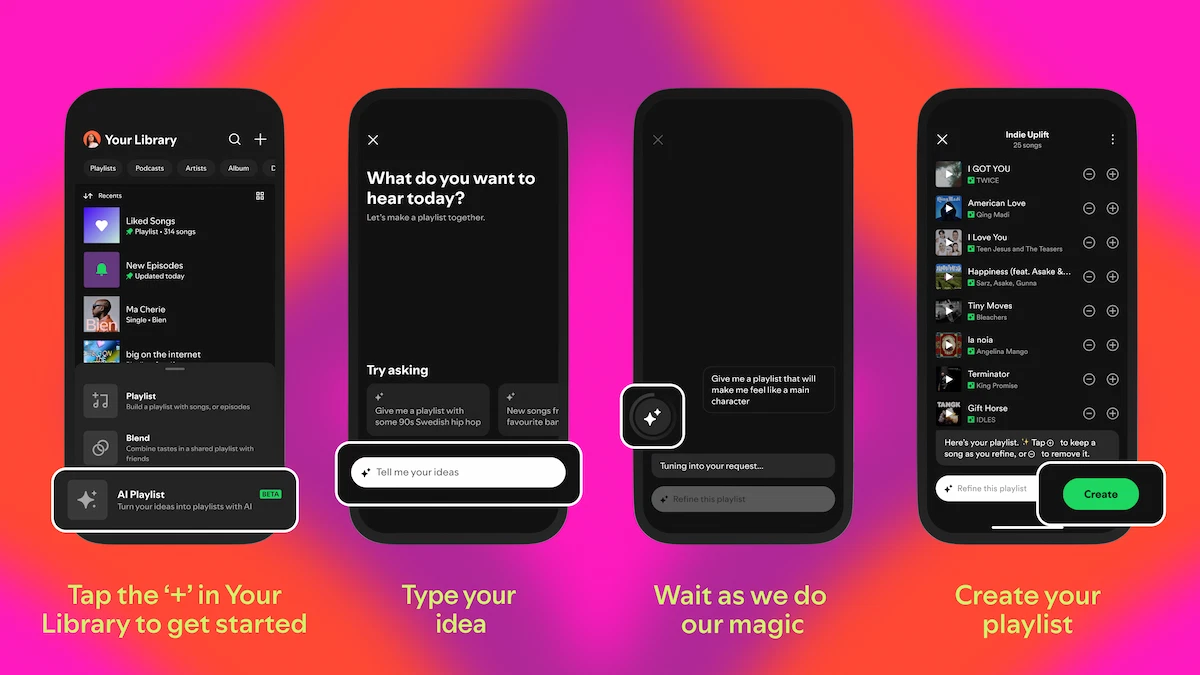
Spotify has quietly rolled out something that sounds simple but could fundamentally change how people interact with music streaming. The feature is called Prompted Playlists, and it does exactly what the name suggests: Premium users can now type a mood, a scenario, or a theme in plain language and get a curated playlist back within seconds.
No manual track selection nor scrolling through genre categories. Just a simple promp and you have your playlist.
It doesn’t sound very significant but actually It is.
What Prompted Playlists Actually Does
The mechanic is straightforward. A user types something like “Rap songs to listen to during my training” or “Monday motivation boost songs” or “Sad breakup songs for me” and Spotify’s system generates a playlist by combining the user’s listening history, broader catalog data, and its own interpretation of the prompt’s context and tone.
The feature is currently live for Premium subscribers in select markets, with wider availability expected in the coming months. For now, it sits alongside existing tools like Discover Weekly and the AI DJ feature, both of which Spotify has been quietly iterating on for years. Prompted Playlists feels like the point where all of that infrastructure finally becomes visible to the average user.
The Shift From Passive to Interactive Discovery
Music streaming has spent most of its existence doing things to you. Algorithms observe your behavior, build a profile, and feed recommendations back. You accept or skip. The loop continues. It works reasonably well, but it is fundamentally passive.
Prompted Playlists inverts that relationship. Instead of waiting to be served music, users are invited to describe what they want in natural language. That shift matters in three concrete ways. Discovery starts to feel like a conversation rather than a vending machine transaction. The friction involved in building a playlist drops to almost nothing. And the time users spend actively engaged inside the app increases, which is exactly what Spotify needs from a retention standpoint.
For a platform competing in an increasingly crowded market, deeper engagement and stronger retention are not abstract goals. They are the difference between a subscriber who stays and one who cancels during a free trial for a competitor.
India Could Be Where This Feature Really Proves Itself
If and when Prompted Playlists expands fully to India, the timing could not be better aligned with how Indian audiences already listen. Streaming users here are young, overwhelmingly mobile first, and tend to navigate across languages and genres within a single sitting in a way that does not fit neatly into Western listening categories.
A user might move from Tamil film songs to global pop to Punjabi rap within the span of thirty minutes. Static genre categories and even standard mood playlists struggle to keep up with that fluidity. A prompt based system that can interpret something like “Sunday morning with a cup of chai, mix of old Hindi and chill English” is genuinely better equipped to serve that kind of listening behavior.
There is also a real question about what this means for independent and emerging Indian artists. If the algorithm behind Prompted Playlists defaults to high engagement, well catalogued tracks, smaller artists could find themselves crowded out even when a user’s prompt would theoretically match their music perfectly. On the other hand, highly specific prompts could actually surface niche artists who would never appear in a standard recommended playlist. Which direction Spotify leans will say a lot about whether it sees this tool as a discovery engine or simply a retention mechanism.
Why This Is Tied to Premium and What That Tells Us
The decision to keep Prompted Playlists behind a Premium subscription is not accidental. Offline downloads and ad free listening were once sufficient to justify the cost of a paid tier. That pitch has gotten harder to make as free tiers have improved and competitors have closed the gap on basic features.
Experiential upgrades are becoming the new frontier of subscription conversion. An AI tool that feels genuinely useful and a little bit magical is a more compelling reason to pay than the absence of ads. Especially in price sensitive markets like India, where the instinct to stay on a free tier runs deep, the platform needs features that make Premium feel like a meaningfully different product rather than just a cleaner version of the same one.
Prompted Playlists is exactly that kind of feature.
What This All Adds Up To
Spotify is not the only platform moving in this direction. Apple Music and YouTube Music are both deepening their AI personalization capabilities, and the competition has clearly shifted from who has the biggest catalog to who can interpret user intent most accurately and most naturally.
Prompted Playlists will not feel revolutionary the first time most people use it. It will just feel easy. And in a market where the average user has four streaming apps on their phone and genuine loyalty to none of them, easy is a powerful differentiator.
For Indian listeners, the real test is simple: does typing a sentence feel better than building a playlist by hand? If the answer is yes, this could become one of the most quietly indispensable features Spotify has ever released.