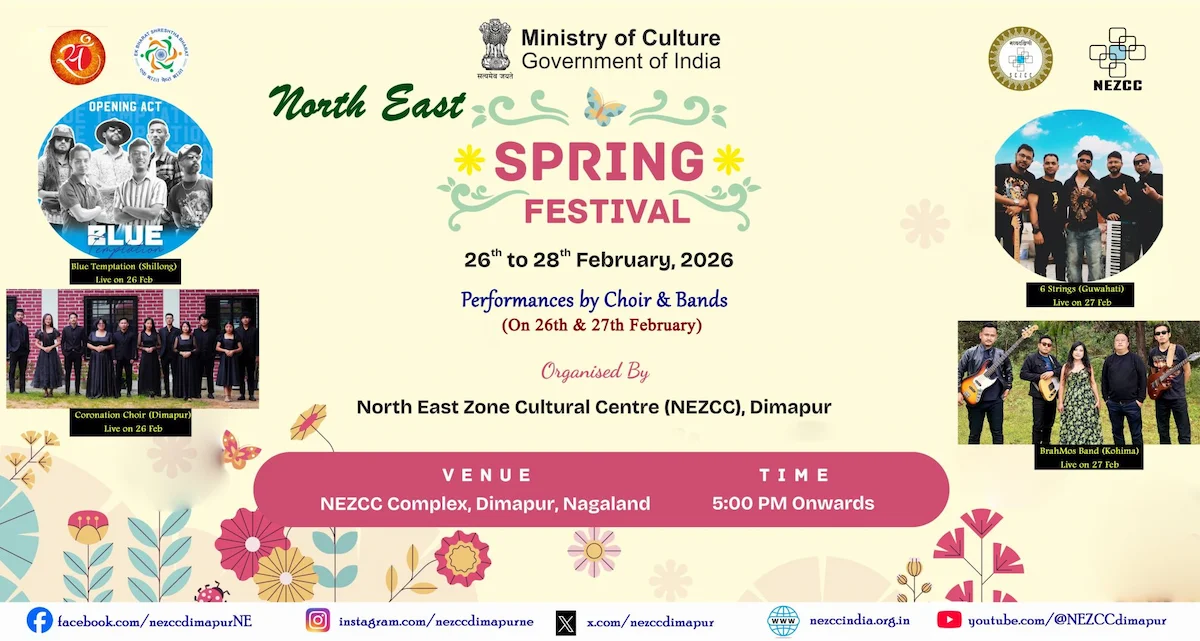
The traditional framework for government-backed cultural festivals has long relied on strict historical preservation, frequently keeping regional folk traditions entirely separate from contemporary independent music. The 2026 North East Spring Festival, initiated by the North East Zone Cultural Centre (NEZCC) in Dimapur, successfully dismantled that separation. By deliberately programming 130 traditional folk artisans alongside some of the region’s most prominent independent acts, the event established a functional blueprint for how regional heritage can actively co-exist with modern artistry.
Programming for a Living Ecosystem
The festival’s curation reflected a sophisticated understanding of how music is actually consumed in the Northeast today. The inclusion of acts like Shillong’s Blue Temptation, Guwahati’s 6 Strings, and Kohima’s Bhramos alongside traditional Cheraw and Wangala performances acknowledged that youth culture and tribal heritage operate in the same continuum.
This scheduling strategy elevated the platform for independent musicians. Sharing a stage with deeply rooted regional traditions and South-Central performers from the overlapping Madhya Dakshini Festival gave these contemporary bands access to an entirely different demographic. They were positioned as a modern continuation of the region’s artistic legacy. The setup validated the indie music scene as an essential component of the Northeast’s cultural identity, worthy of the same institutional support and center-stage placement as heritage art forms.
Expanding the Live Corridor
Beyond the curation, the festival’s geographical footprint offered a pragmatic solution to a persistent challenge in the independent music sector: touring infrastructure. Rather than remaining confined to the NEZCC Complex in Dimapur, the festival actively expanded its reach, programming extended dates in Namsai, Arunachal Pradesh, and Ri-Bhoi, Meghalaya.
This multi-city approach effectively established an active, government-supported live music corridor. For independent musicians navigating the logistical and financial hurdles of organizing regional tours, an institutional circuit provides crucial momentum. It allows artists to consolidate their presence across state lines, playing to built-in audiences while minimizing individual financial risk. When distribution networks like Ziddi deliver the recorded catalogs of these regional artists to global streaming platforms, the data consistently shows that regional live visibility translates directly into sustained digital discovery. The physical stage anchors the digital footprint.
A Blueprint for Integration
The collaboration with the South-Central Zone Cultural Centre brought an added layer of cross-cultural exchange, introducing dance and music traditions from Maharashtra, Karnataka, and Chhattisgarh to the Northeastern audience. The resulting environment proved that cultural showcases do not have to be isolated regional echo chambers.
By funding a platform where a blues rock band from Shillong, a folk choir from Dimapur, and traditional performers from Madhya Pradesh all share equal billing and audience attention, the 2026 North East Spring Festival achieved a rare structural victory. It demonstrated that institutional support for the arts can be deeply respectful of heritage while remaining entirely relevant to the independent creators defining the current cultural moment.